The Office is my favorite show for a lot of reasons, but my favorite reason is Michael Scott. Even though he is the boss, and I never will be one, I identify with him the most, because we are so alike. Being incompetent is the biggest similarity, but there is also our constant need to be acknowledged and loved. In addition, we share the ability to be both funny and unintentionally funny. We share both the desire to be good at improv and our ability to mess up phrases. “Fool me once, strike one. Fool me twice…strike three,” or “I am not to be truffled with.” I’ll not share the phrases I’ve messed up, because they aren’t near as funny as his are, and to be dishonest, I can’t think of any at the minute, and I only have so much time to finish this blog.
One of his quotes I identify with the most is when he accidentally did a good job by being the only branch at Dunder Mifflin making a profit and David Wallace called him in to ask him how he did such a good job.
He tells David Wallace something that I think about almost every time I do a blog post.
“Sometimes I’ll start a sentence (or blog) and I don’t even know where it’s going. I just hope I find it along the way.”
I don’t know how other bloggers work, but I work by the seat of my pants. I assume that some of you put a lot of hard work and effort into a post and plot and plan it for a couple of days. I wish that was the way I worked but it isn’t. My process is at best, think of a word, phrase, sentence, or idea. Marinate about it for 10 or so seconds, and then write it down on my phone. Then, when I have a minute, pull up an empty blog post, and then to paraphrase what Michael Scott said, “Start writing a sentence and not know where it is going.”
I describe my writing as the Improv style.
Some actors and comedians are famous for their Improv acting style. Actors like Jim Carrey, Steve Carell and Ryan Reynolds have famously changed scripts by constantly coming up with funny lines on the fly. I even heard that Robert Downey Jr. improvised his last line in Avengers End Game, after Thanos said, “I am inevitable.” and he said, “And I…am Iron Man.” These tales of unscripted lines could be legend for all we know, but it adds a bit of magic, or insanity to the storytelling process if it is true.
Recently, I heard this new word to describe improving. Vamping. I had to look it up, because I heard people using it and I figured it out context wise, but I wanted to know for sure. A website I found said, “Vamping is creatively stalling for time.” As soon as I heard that, I took the Delorean back in time to Memory Lane and thought about all those times I had to do book reports and later when was asked to speak in front of crowds. I was usually given a certain amount of time to speak or present a lesson and I was a little less than prepared.
I remember a few times when I had to vamp. Sometimes it actually came out much better than expected and other times…epic fails where my face turned as red as Dwight Shrutes beets. The stammering and the umms came hard and fast and furious as Vin Diesel and my breath was as dry as the erase board I was using.
Some people say they would rather die than epic fail on a public speech, but I would rather live. Only a small percentage of people are good at public speeches so who cares about them? Who really remembers the point of your speech 10 seconds after you give it? More people will remember your vamping, good or bad, than remember your properly prepared statements.
That’s why most famous speeches come when someone says, “I had prepared a statement today, but I’m not going to read it. I’m going to speak from the heart.” At least that’s what they say in TV and movies, when the idea to rip up the speech was in the script. But you get the point. That’s why I stopped preparing speeches. My most prepared jokes always fell flat, but the ones that I make up in the moment always gets laughs (mostly at me).
You know Lincoln’s most famous speech; The Gettysburg Address was vamped right? We know that because he was in the movie Abraham Lincoln: Vampire Hunter, which is the true story of Lincoln slaying vampires before he became the president. I found it pretty historically accurate and it was a great backstory to explain why he was so good at vamping speeches.
Vamping is a great skill to learn, because it can get you out of some sticky situations, like Michael Scott teaching David Wallace all the good things he was doing at Dunder Mifflin Scranton, or Abe Lincoln creating the one of the most famous speeches in 272 words. His example taught us that the shortest speeches are the best speeches. I always think that if the greatest president in US History (and star of Bill and Ted’s Excellent Adventure) can do a short speech, so can I. As you can tell, I still have 200 more words in my book report, but I’ll fill the rest of the time with Giftures (which are worth 10,000 words) to distract you and take up the rest of my time…
Sometimes I’ll start a blog post…
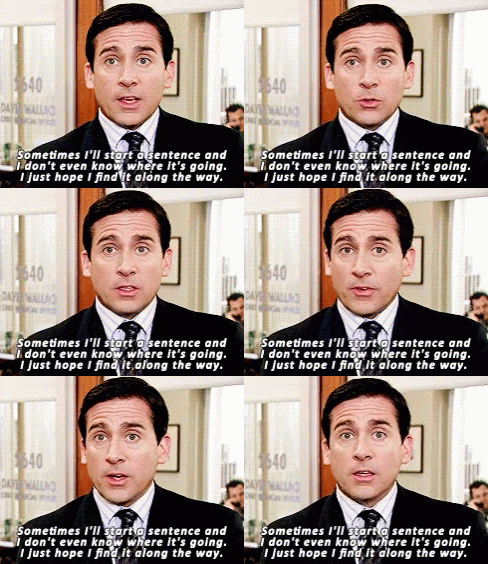
Michael Scott and I…

They are always trying to make us…

Jim Carrey improvising…

Ryan Reynolds vamping with cool catchphrases…

Some of cinema’s best lines…

Most people don’t remember…
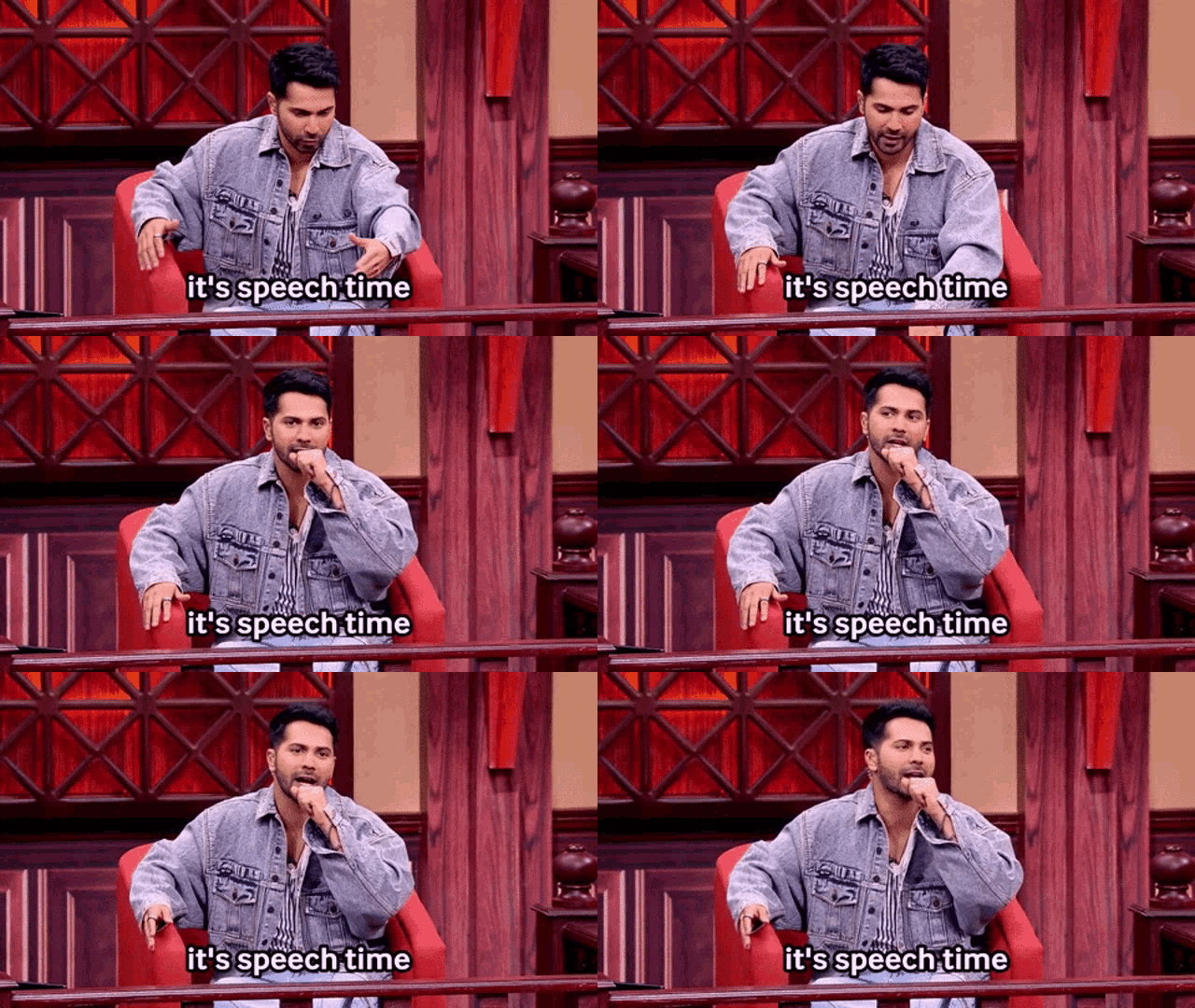
But they will definitely remember…

The best speeches…

Abraham Lincoln’s most famous speech…

Which he learned from his time…

And that, my friends, is how to Vamp a blog post.
You’re welcome.
ARRRGGGHHHHHHH
Bitter Vamping with Vitterness
 Ben's Bitter Blog
I didn’t even know what to comment but watch me go!
LikeLike
Probably a good idea.
LikeLike
Okay, so Merriam Webster has a very different definition of vamping than yours. I am bad at both kinds. The only kind of improv I’m somewhat good at is telling silly stories for kids, because kids don’t care how ridiculous my stories are.
LikeLike
I don’t really believe the Merriam Webster dictionary, which Michael Scott used in an episode of The Office once, but that is a story for another time. So, when you say you don’t improv, does that mean your blog posts are all planned out and worked on for days?
LikeLiked by 1 person
No, I guess I wing those, too. But then, they are unsophisticated and pretty ridiculous, kind of like children’s stories.
LikeLike
If you haven’t noticed most of mine are pretty ridiculous as well, IE talking about aliens and children stories. Is your blog still tiare75.wordpress.com? If not, what is it? I can’t seem to find it.
LikeLiked by 1 person
I changed it to jupitergirlwrites.wordpress.com to keep the real life peeps away.
LikeLike
That makes sense, you know, with the The Girl From Jupiter thing and to keep real life peeps away. Good thing I don’t exist in real life.
LikeLike
great show
LikeLike
Yeah, the Office is pretty classic.
LikeLiked by 1 person